


Understanding the Strategic Planning Process
Leaders love to use the phrase “being strategic” when discussing the future, but they hardly care to explain what that means or how they are going about it. Often this phrase is used to hide the real game plan (or in some cases, the lack of one). But how can you truly be strategic? When trying to be intentional in your future actions, it’s common to discuss a strategic plan; however, analysis paralysis can easily occur with the amount of certified decision frameworks, making it hard to know where to start.
This guide boils strategy down to three clear stages: Input, Matching, and Decision. Each stage has a specific purpose. The Input Stage identifies what factors are at play, the Matching Stage will generate different viable options, and lastly, the Decision Stage will integrate all analyses to determine a final choice. Understanding this 3-stage strategic planning process can make these models stop feeling like theory and start to become real, actionable insights that you can execute on.
Why Strategic Planning Matters for Businesses
Strategic planning is more than just an executive boardroom decision. It is used for company initiatives, projects, teams, and everyday business decisions. It is how a company goes from where it is today to where it needs to be. Without a direction forward, organizations will quickly fall into reaction mode, putting out fires rather than building the future, looking backward rather than forward. A strong strategic plan sets the foundation for clarity, alignment, prioritization, and navigation.
If a man knows not to which port he sails, no wind is favorable.
— Seneca the Younger
Following a structured strategic planning process removes any guesswork or misdirection. It aids in transforming competitor data, internal resources, and external threats into a plan of action. Additionally, this minimizes the Sunk Cost Fallacy, helping decide when to ‘stay the course’ or make a change. The importance is on evaluating data in a structured and objective manner. This ensures a disciplined 3-stage process provides a competitive advantage over occasional intuition. Ultimately, strategic choices separate companies into those that thrive and those that survive.
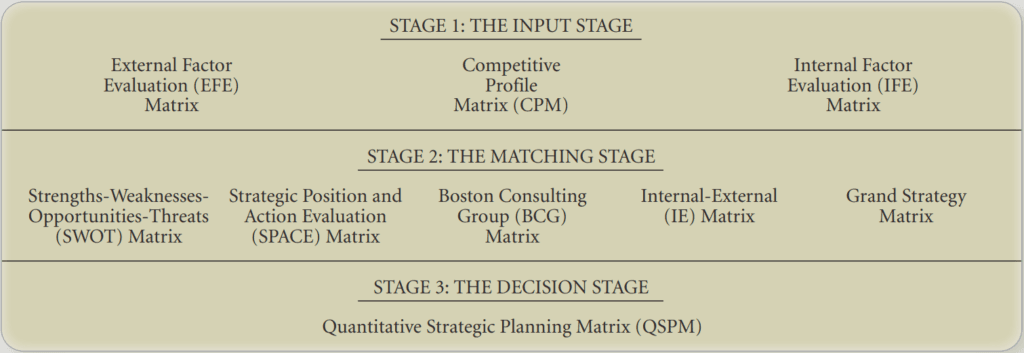
The Strategic Management: A Competitive Advantage Approach1 is the gold standard textbook for providing a practitioner-oriented perspective, engaging both theory and actualizations. This visual framework helps organize the best industry-standard strategy frameworks to create a repeatable 3-stage strategic planning process.
Stage 1: The Input Stage
The Input Stage collects the data necessary to understand both the internal and external business environments. Three frameworks are utilized: the External Factor Evaluation (EFE) Matrix, Internal Factor Evaluation (IFE) Matrix, and Competitive Profile Matrix (CPM). While all three aim to provide insights, they differ in focus and purpose.
EFE Matrix vs IFE Matrix
EFE and IFE look at a business from two opposite lenses. Externally, such as large-scale economic factors (GDP, inflation, and interest rates); political factors (regulations, trade agreements, and political instability); and technological advancements, alongside environmental, social, and cultural trends. Internally, leadership, marketing, research and development, and finance. Overall, EFE can be simply considered outside of the company’s control, while IFE covers anything within control of the business.
CPM vs EFE and IFE
Unlike the EFE and IFE matrices, the CPM specifically compares the business to its direct competitors. This makes CPM a better benchmarking tool.
EFE and IFE provide the overarching topic of the conversation, such as rising inflation or cost of imported goods, and CPM aids in determining how well positioned you are to weather the storm in comparison to competitors.
The Input Stage offers three important viewpoints: external factors (EFE), internal factors (IFE), and relative competitor positioning (CPM).
Stage 2: The Matching Stage
The Matching Stage helps determine which specific items the company can (or can’t) control and how to properly prepare for them. Although it’s stated that the five techniques can be utilized in any sequence, I’ve found that this simple process can be beneficial and logical. Here are the five models listed:
- SWOT Matrix (Strengths, Weaknesses, Opportunities, Threats)
- BCG Matrix (Boston Consulting Group Matrix)
- IE Matrix (Internal–External Matrix)
- Grand Strategy Matrix
- SPACE Matrix (Strategic Position and Action Evaluation)
SWOT Matrix
SWOT is considered a great starting point. Often this can be used to brainstorm the entire layout of a business. It is broad and flexible, helping determine which attributes fit into specific categories: strengths, weaknesses, and opportunities.
BCG Matrix vs IE Matrix
Both BCG and IE are portfolio-based tools, a great current check-in on current product standings, but they differ in scope. The BCG Matrix focuses on market share (internal measure) and industry growth (external measure), categorizing items into Stars, Cash Cows, Question Marks, or Dogs. It’s ideal for product-level or division-level analysis. The IE Matrix, however, is broader and integrates the input data from the IFE and EFE scores. It weights the scores and places them onto a nine-cell grid, which are grouped into three major strategic implications (grow, hold, and harvest). BCG is more visual and simple, while IE is comprehensive and integrative. Here is a prime example of how the stages begin to flow from data to understanding to decisioning.
Grand Strategy Matrix vs SPACE Matrix
Finally, the Grand Strategy Matrix and the SPACE Matrix both provide strategic direction. The Grand Strategy uses two dimensions, market growth and competitive position. This represents a broad conceptual direction, while SPACE adheres to a more verified quantitative directional analysis.
Stage 3: The Decision Stage
The Decision Stage has only one model: the Quantitative Strategic Planning Matrix (QSPM). This is where the strategic planning process supports the creation of a final, prioritized direction.
QSPM vs Matching‑Stage Models
While the Matching Stage models generate options, the QSPM is about choosing among them. It does this by assigning weights and attractiveness scores to each strategy. For example, if SWOT generates multiple SO (strengths and opportunities) strategies and the BCG Matrix suggests investment in a “Star” product, the QSPM evaluates which of these alternatives offers the greatest overall benefit.
Why QSPM Stands Alone
Unlike the other stages, which present multiple tools, the QSPM is the only model in the Decision Stage because it is designed to integrate all prior analyses. It takes the factors identified in the Input Stage and the options generated in the Matching Stage and aims to quantify a final choice as objectively as possible, using structured managerial input.
Combining qualitative and quantitative reasoning, the QSPM takes inputs and ensures a grounded, actionable, strategic direction.
Strategic Planning Does Not Have to Be Complicated
Logical progression: collect data, generate options, and quantify decisions. This is the reason the 3-stage strategic planning process provides successful direction. It provides the foundation for a firm understanding, structured analysis, and an executable outcome. “Strategy” should not be a buzzword. Instead, it should be a clearly defined direction based on a wealth of information and structured forethought.
- David, Fred R., and Forest R. David. Strategic Management: A Competitive Advantage Approach, Concepts and Cases. 18th ed., Pearson, 2024. ↩︎